



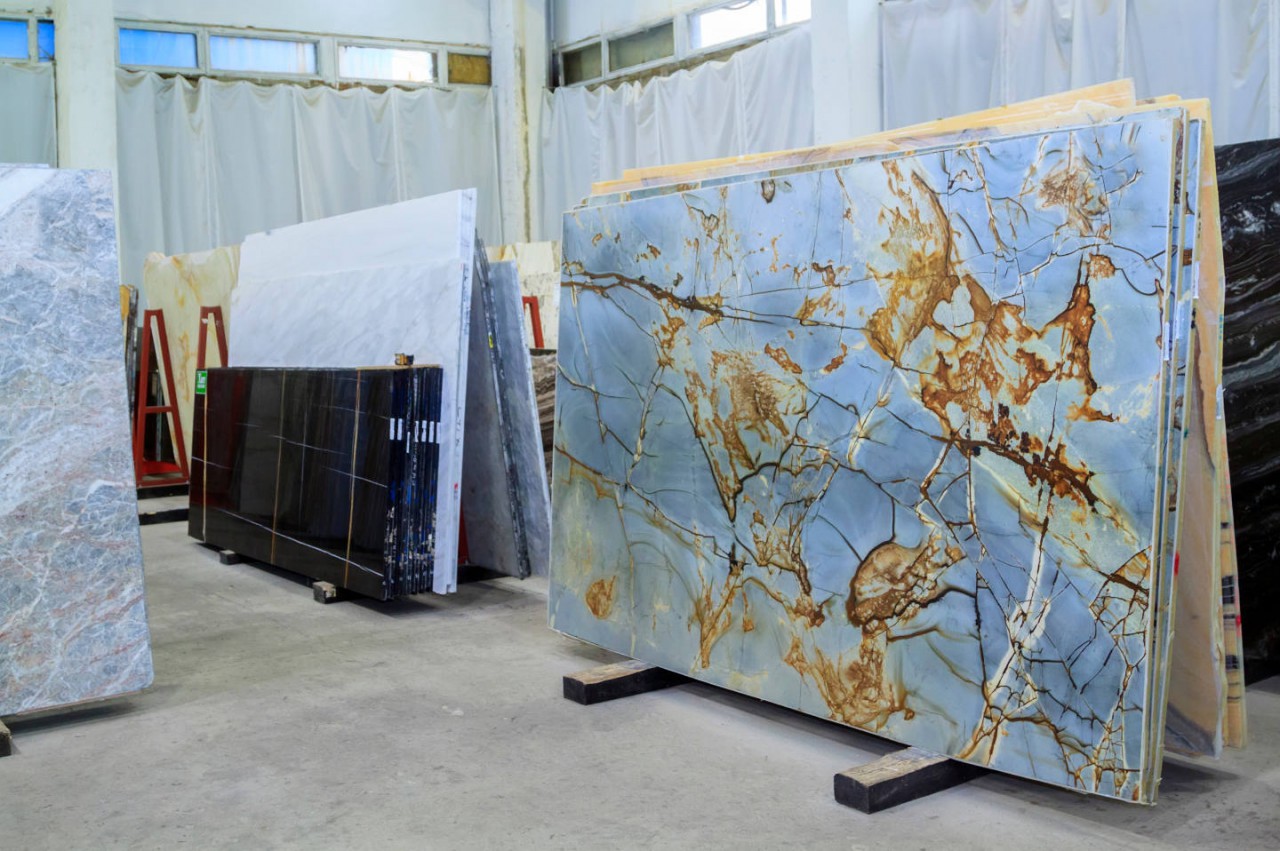
Marble has been popular for millennia, since the times of Ancient Greece and Rome, and deservedly so. It’s a natural material that can vary greatly in appearance depending on where it was quarried and how it was cut. A pure calcite marble can be white, whereas the presence of hematite can turn it red, and other minerals can add intricate veining to the surface. In this post we will go over a few tips that should help you choose a marble slab for your countertop that suits your needs and personal style.
A white marble slab will hide stains betterYou might want that blood red hematite marble slab for your countertop or maybe that sleek black limestone, but you have to pause and think first. How do you plan to use your kitchen? Will you be cooking on it often? Will you be using acidic substances like lemon juice and vinegar? Marble consists mainly of calcite carbonate or magnesium carbonate and thus reacts with acids. When you spill lemon juice or vinegar on your countertop it can etch and leave a white stain, one that will be significantly more visible on a black marble slab than a white one. You could also consider a dolomitic marble like Bianco Volakas which is over 90% dolomite and thus reacts more weakly with acids than calcite marbles.
Think about how different marble slabs will fit togetherEven when marble slabs come from the same block, there can be some variance in coloring and veining, so it is best to handpick the specific ones that will be used for your countertop, if possible. Look for a single slab with a pattern that captivates you, but also consider two bookmatched marble slabs with a beautiful, symmetric mirrored pattern.
Take veining patterns into considerationDifferent cuts of the same block can produce strikingly different veining patterns. A fleuri cut produces flowery, abstract patterns that can give bookmatched marble slabs that distinct Rorschach test look. On the other hand, a striato cut produces striated slabs and emphasizes the veins. It can create patterns with straight, parallel lines that travel along your countertop and down the side, if you use a second marble slab for the corner.
The finish will greatly affect the look of your countertopIn the millennia humans have been working with marble, technology has made such progress that today we have methods of brushing and polishing stone that our ancestors couldn’t have imagined. A honed finish is silky smooth to the touch but maintains a matte look. A polished finish, on the other hand, goes a step further and creates a glossy, reflective look, one that is indeed very popular among marble enthusiasts. The tumbled finish gives marble an aged, antique look through a stone bath of grit or sand. Finally, the brushed finish is achieved by brushing the marble with steel or hard nylon. It’s a textured and wear-resistant finish that hides etching well.

We are the manufacturers of some of the leading products in today's stone industry. Our equipment, our inventory, and our 90-year experience can assure the success of your project
745 West 18th Street, Building #4, Hialeah, Florida 33010
+1 305-477-6339
e1@interstoneltd.com